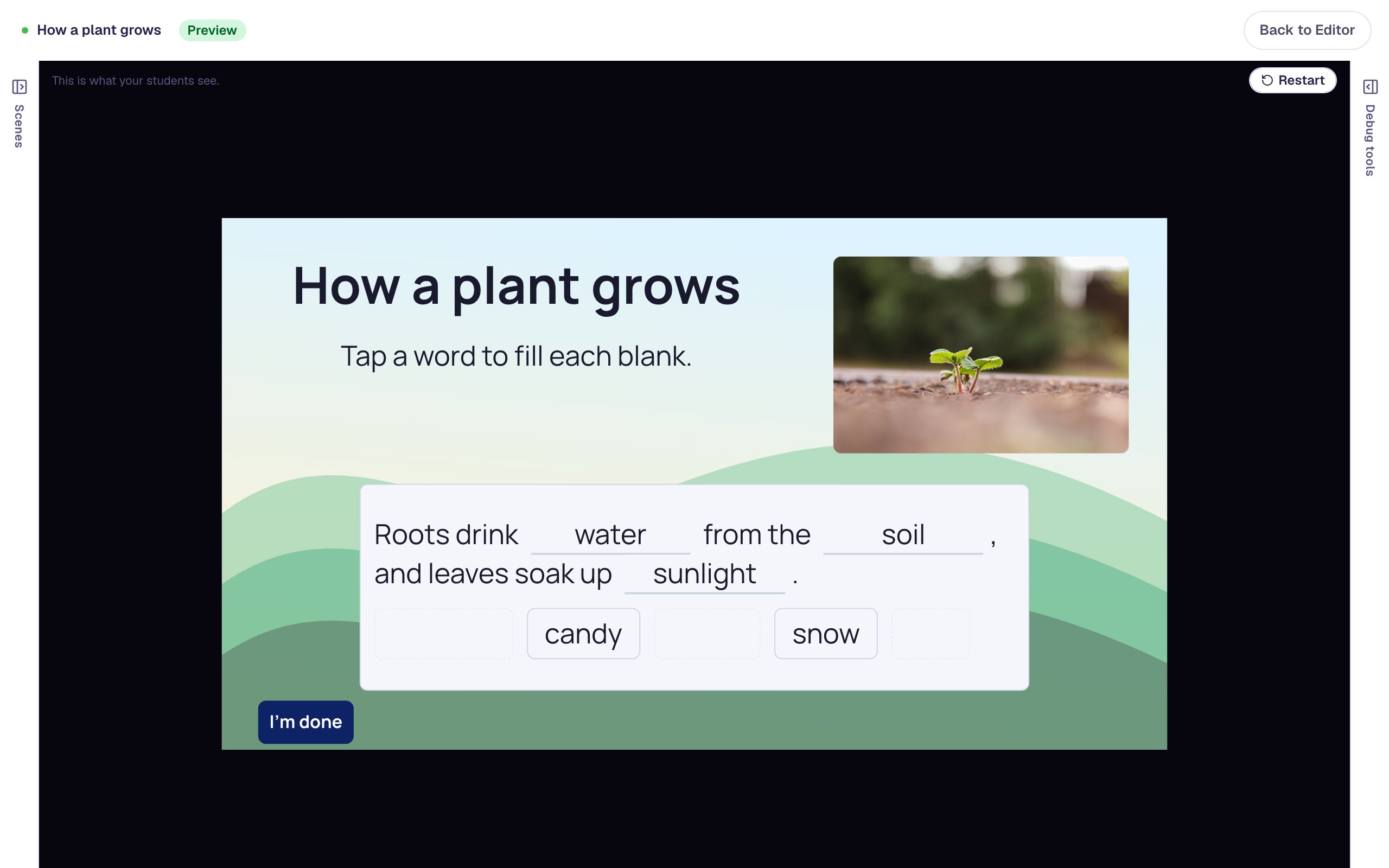
Show tenths and hundredths with base-ten blocks
Make a flat worth 1 whole so the same base-ten blocks show decimals. Students read 1.25 from a model on a place-value chart, then build 1.3 themselves, with a hint for the classic 1.03 mix-up.
- Level
- Intermediate
- Time
- About 15 min
- Steps
- 9
- Updated
- Nov 4, 2026
A two-scene decimals lesson where students type the number a model of flats, rods and small cubes shows, then build 1.3 on a place-value chart and get a hint if they put the 3 in the hundredths.
Get the finished lesson
Skip straight to the result, or keep it open beside the steps. Add this tutorial's lesson to your account and explore how it works in the studio.
Free to sign up, and you'll come straight back here. I have an account
Fourth graders meet decimals with the blocks they already know. Call a flat 1 whole, and a rod becomes one tenth and a small cube one hundredth. Students can then see why 1.3 and 1.03 are different numbers: three rods are not three small cubes.
In this tutorial you'll build a two-scene lesson called Tenths and hundredths:
- On the first scene, students read a model of 1 flat, 2 rods and 5 small cubes on a place-value chart and type the number it shows.
- On the second, they build 1.3 themselves. If they put the 3 in the hundredths (1.03), a hint asks how many tenths 0.3 is.
If you haven't used Base-Ten Blocks before, start with Build a three-digit number with base-ten blocks: this tutorial uses the same trays, Done button and hint.
Step 1: Set the scene
Start a blank lesson (New lesson, then Start from scratch) and name it Tenths and hundredths by clicking Untitled lesson at the top left.
Click an empty spot on the scene, open Background, click Choose a style, and pick Lagoon gradient under Gradients. Give the Closing Scene the same background so the ending matches.
Then add what students read first:
- A Heading at the top:
What number do the blocks show?. Set its Font Size to40. - A Body under it:
A flat is 1 whole. Count the flats, rods and small cubes, then type the number.Set it to Fixed width,880wide, then set its Font Size to22.
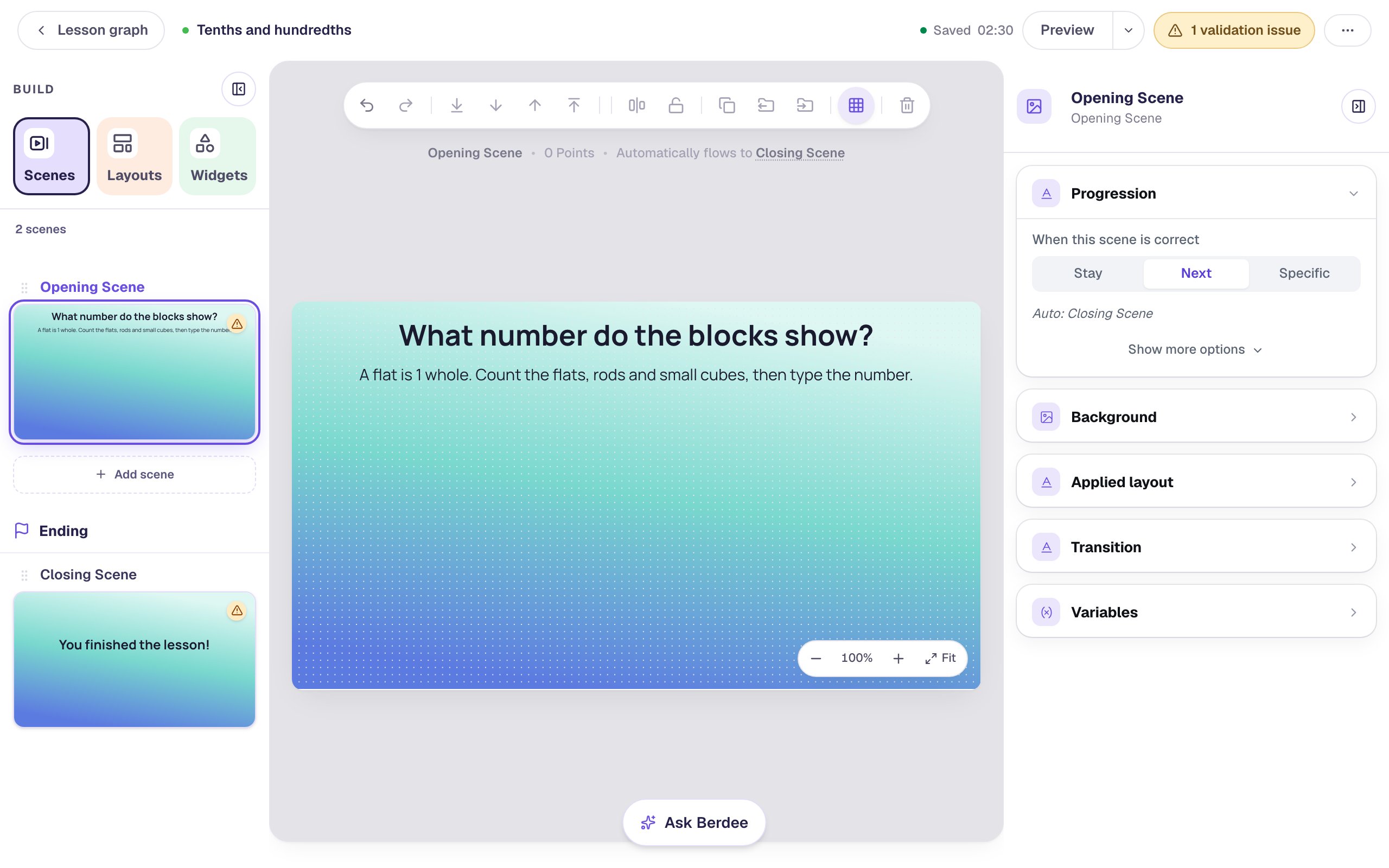
The sentence matters: a flat is only 1 when you say so. Students who have used the blocks for whole numbers will read a flat as 100 unless they're told.
Step 2: Add the blocks
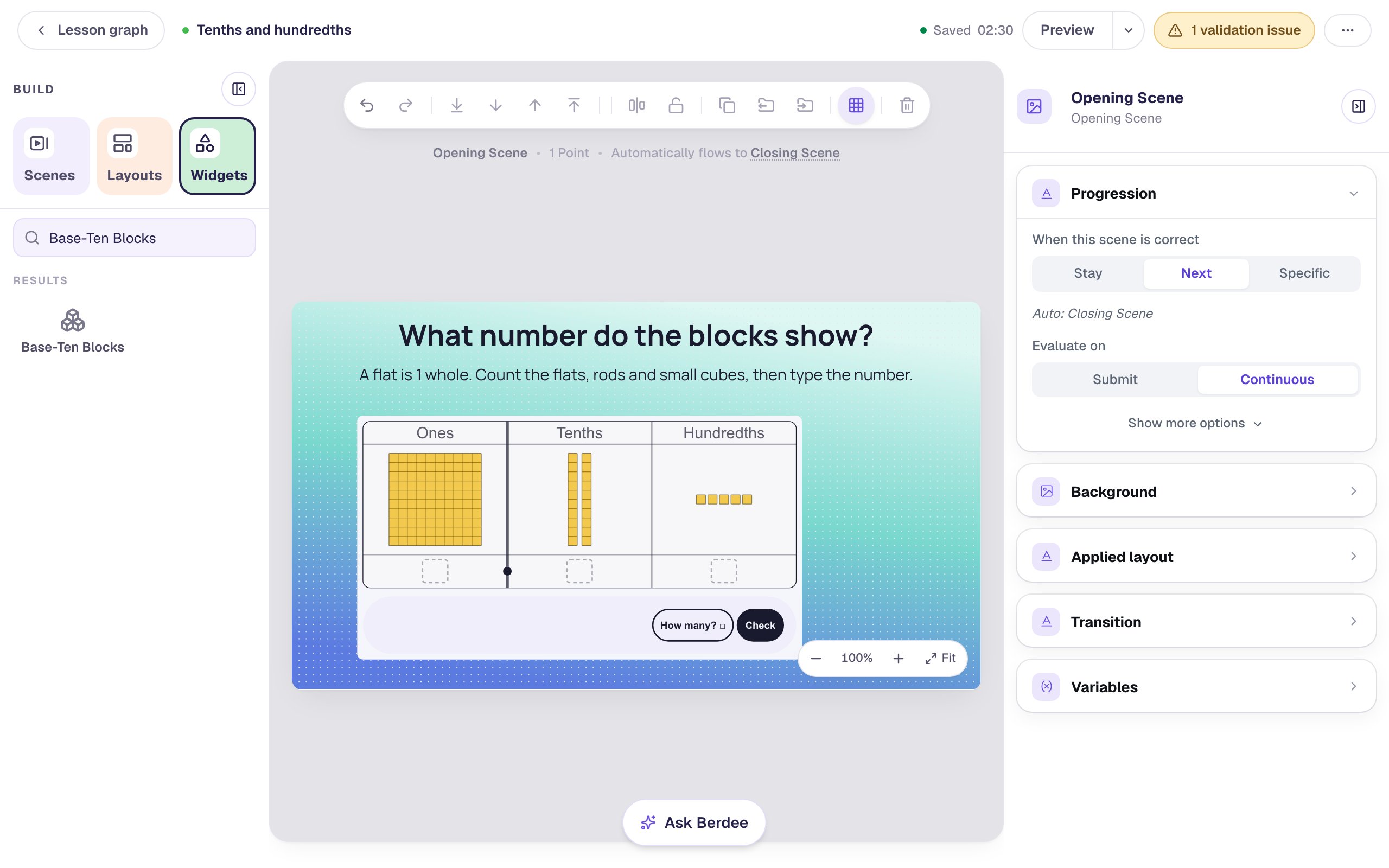
Open the Widgets tab, search for Base-Ten Blocks and click it. Rename the widget Read the blocks (double-click its name at the top of the properties panel), so you can tell it apart from the second scene's blocks in conditions and on the attempt page.
Make it 620 wide and 340 tall, and drag it under the sentence, a little left of center.
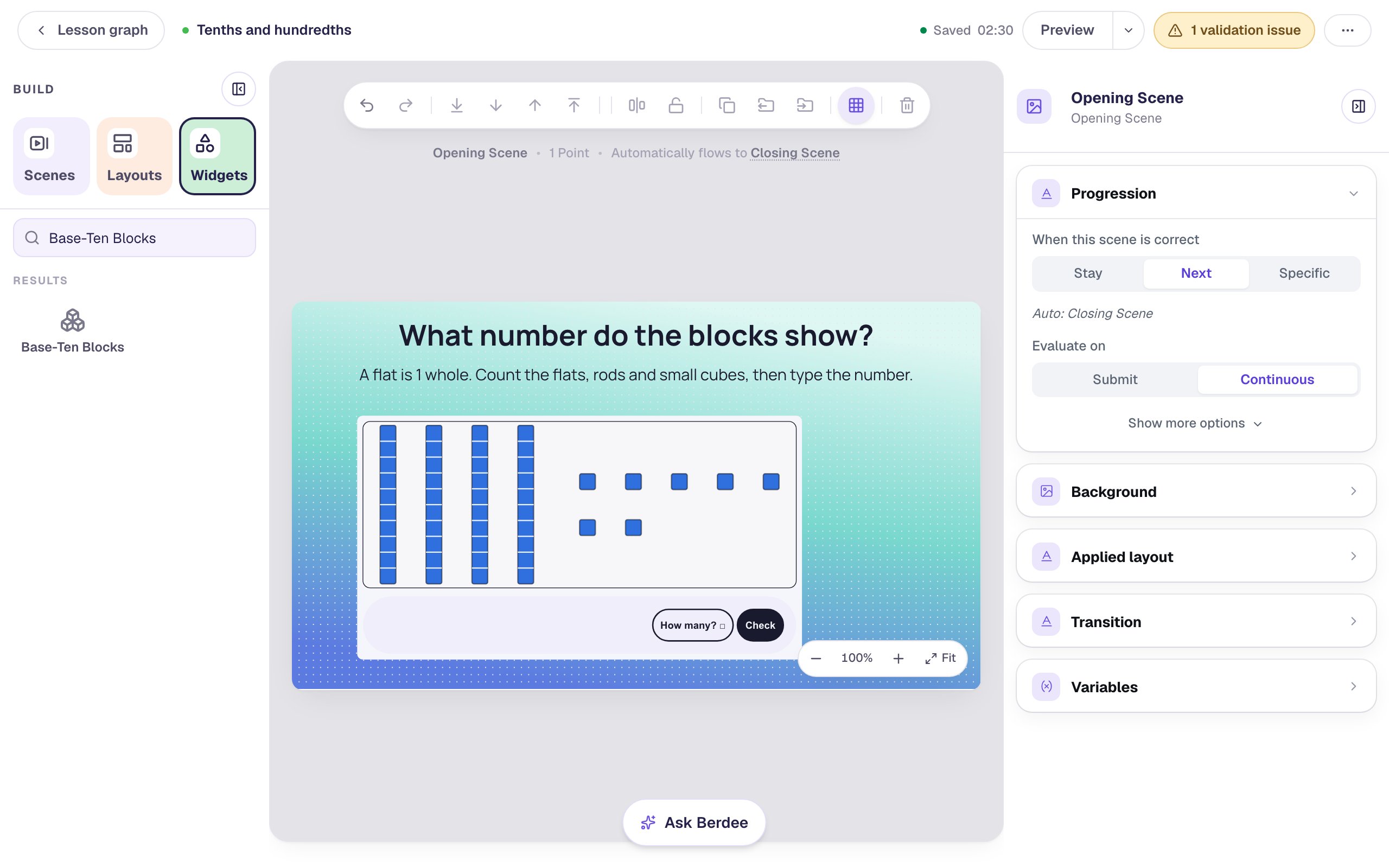
Step 3: Make a flat 1 whole
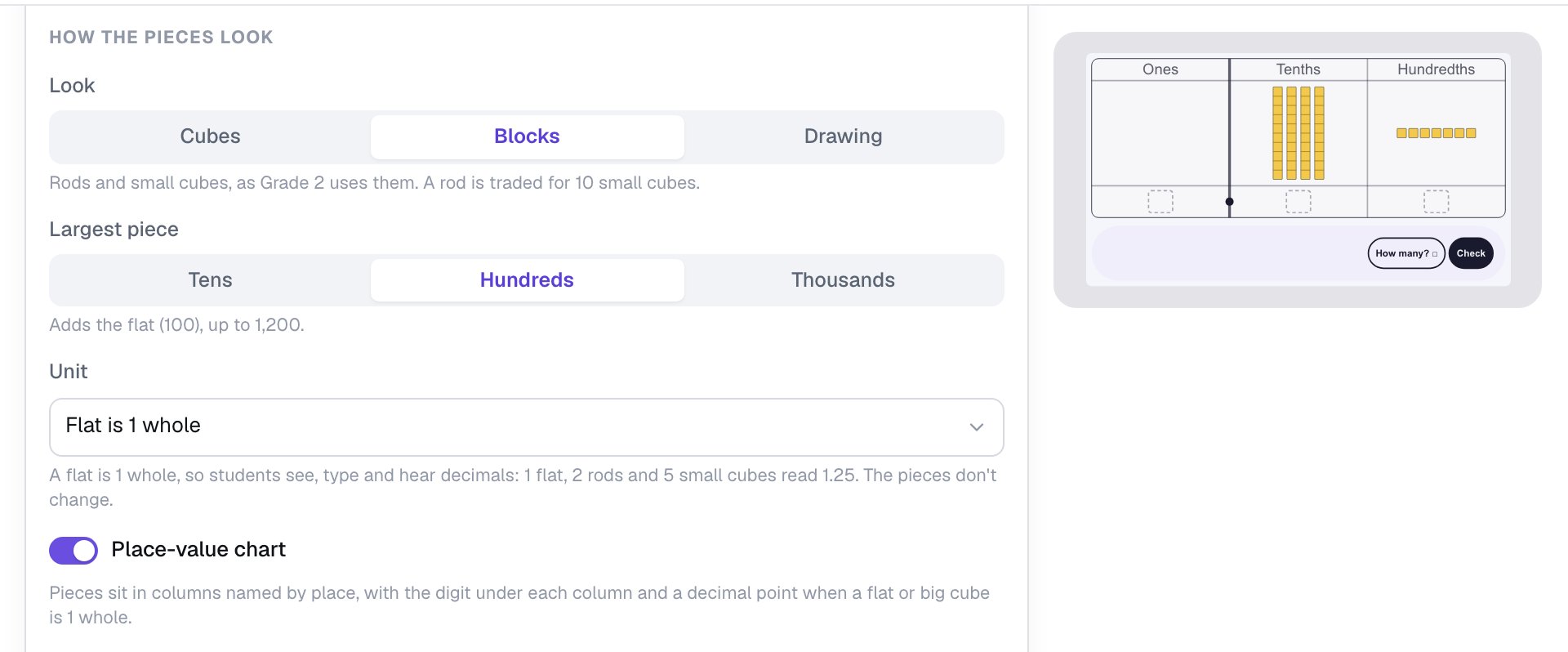
With the blocks selected, click ⚙ Configure above them. Under How the pieces look:
- Set Look to Blocks, so the pieces are the flats, rods and small cubes students hold in class.
- Set Largest piece to Hundreds. This adds the flat.
- Set Unit to Flat is 1 whole.
- Turn on Place-value chart.
Unit changes what the pieces are worth, not what they look like: a rod is still a rod, but it now reads 0.1. The place-value chart puts each kind of piece in its own column (Ones, Tenths, Hundredths) with a dot for the decimal point, so students see where each digit comes from.
Step 4: Build the model students read
Still in ⚙ Configure, scroll up to What students do and choose Show. Students won't build anything here: they read a model you make and say what number it is.
Under The model, the widget still holds its sample model of 47 (4 rods and 7 small cubes), and the + buttons add to it. So replace the counts instead: in the boxes next to Or type, type 1 flats, 2 rods and 5 small cubes. The line above the boxes reads 1 flat, 2 rods and 5 small cubes: 1.25. Then, under How it's checked, set Answer to How many?.
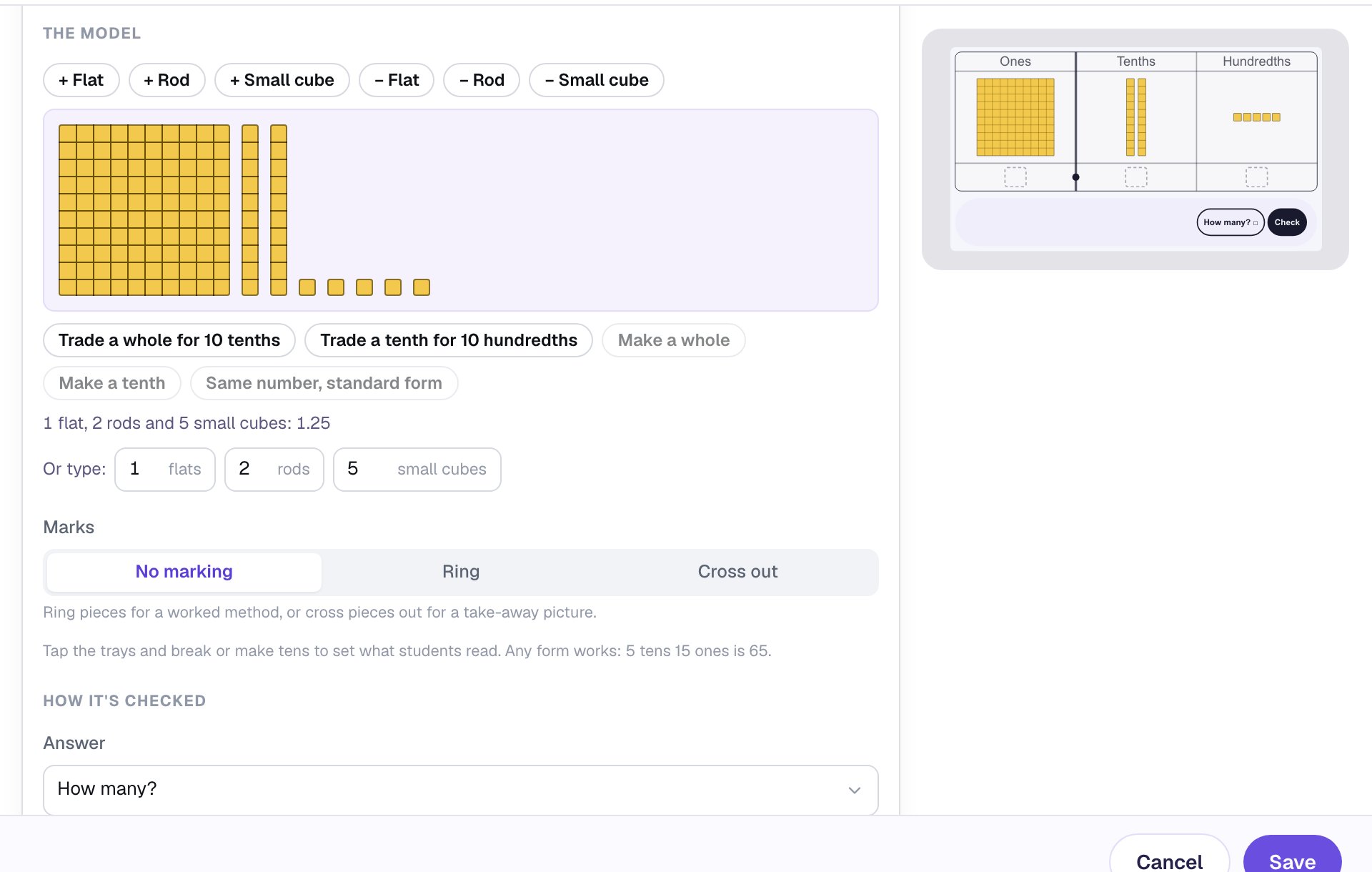
You never type the right answer: Berdee counts the model and expects 1.25. Change the model later and the answer changes with it. Click Save.
Step 5: Add a scene where students build 1.3
Open the Scenes tab and click Add scene. The new scene goes in before the ending, and the left panel switches to Widgets, ready for the first widget. Click Scenes to come back, then double-click the new scene's name and rename it Build 1.3.
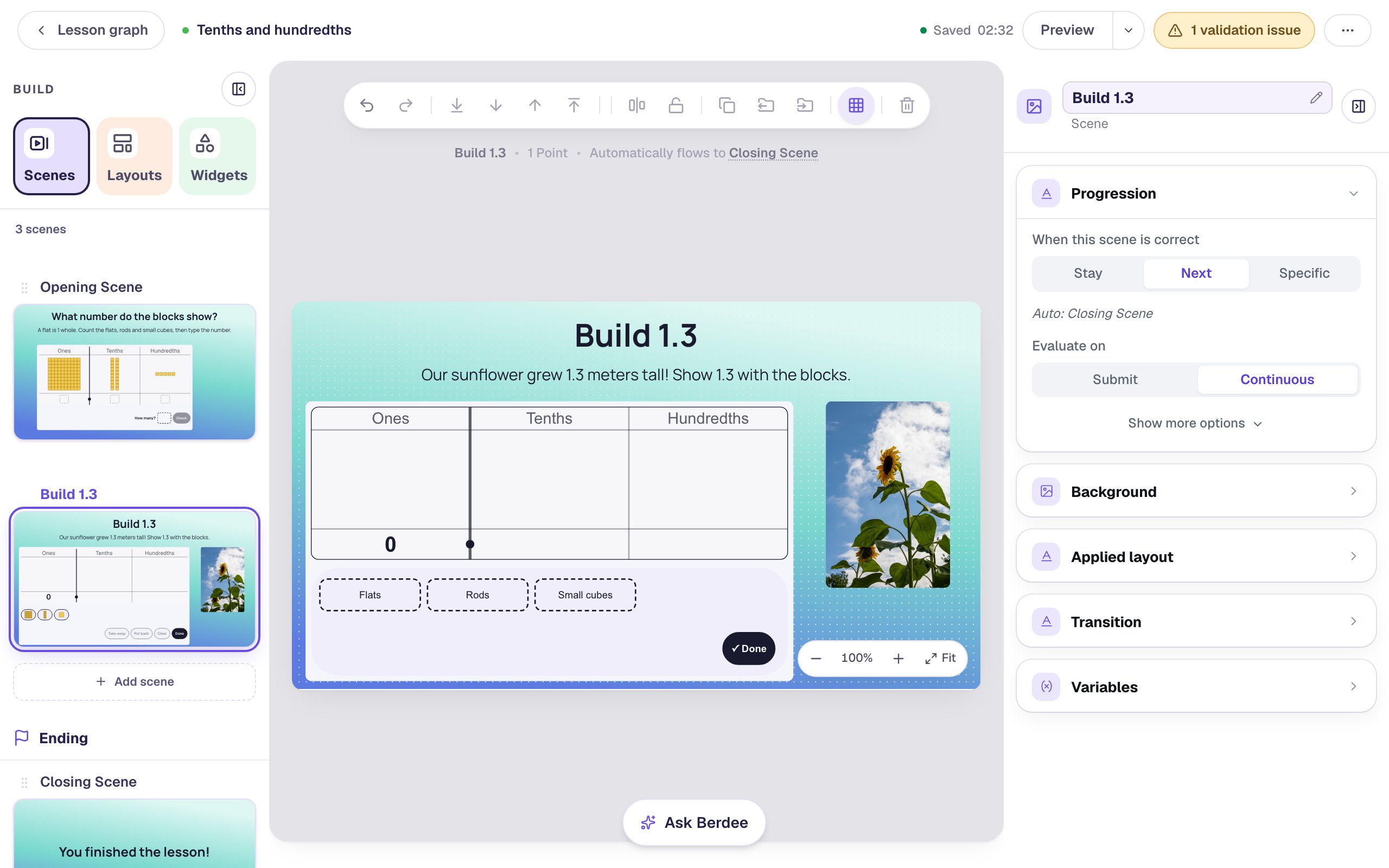
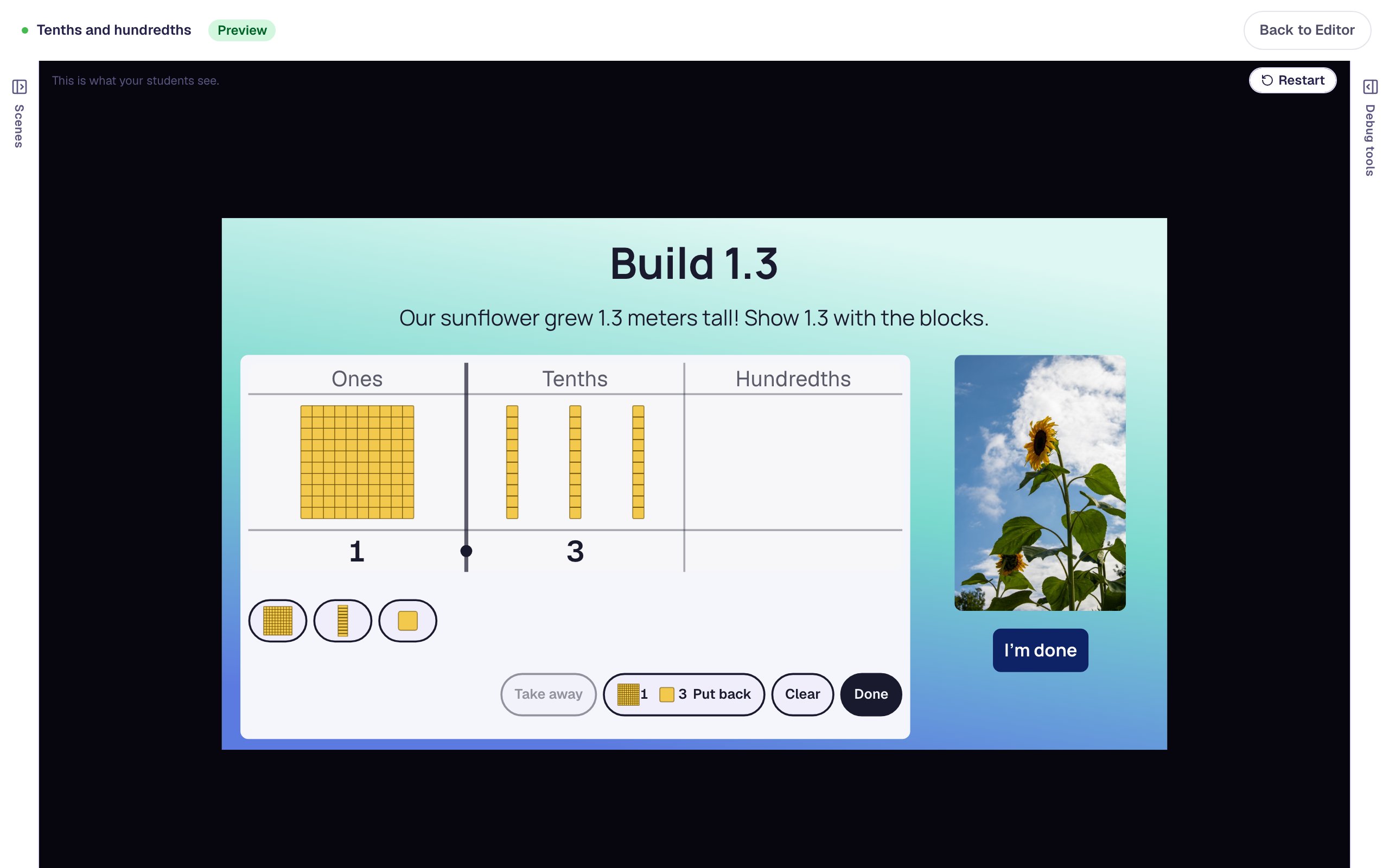
Give it the same Lagoon gradient background, a Heading Build 1.3 (Font Size 44) and a Body Our sunflower grew 1.3 meters tall! Show 1.3 with the blocks. (Fixed width, 880 wide, Font Size 22).
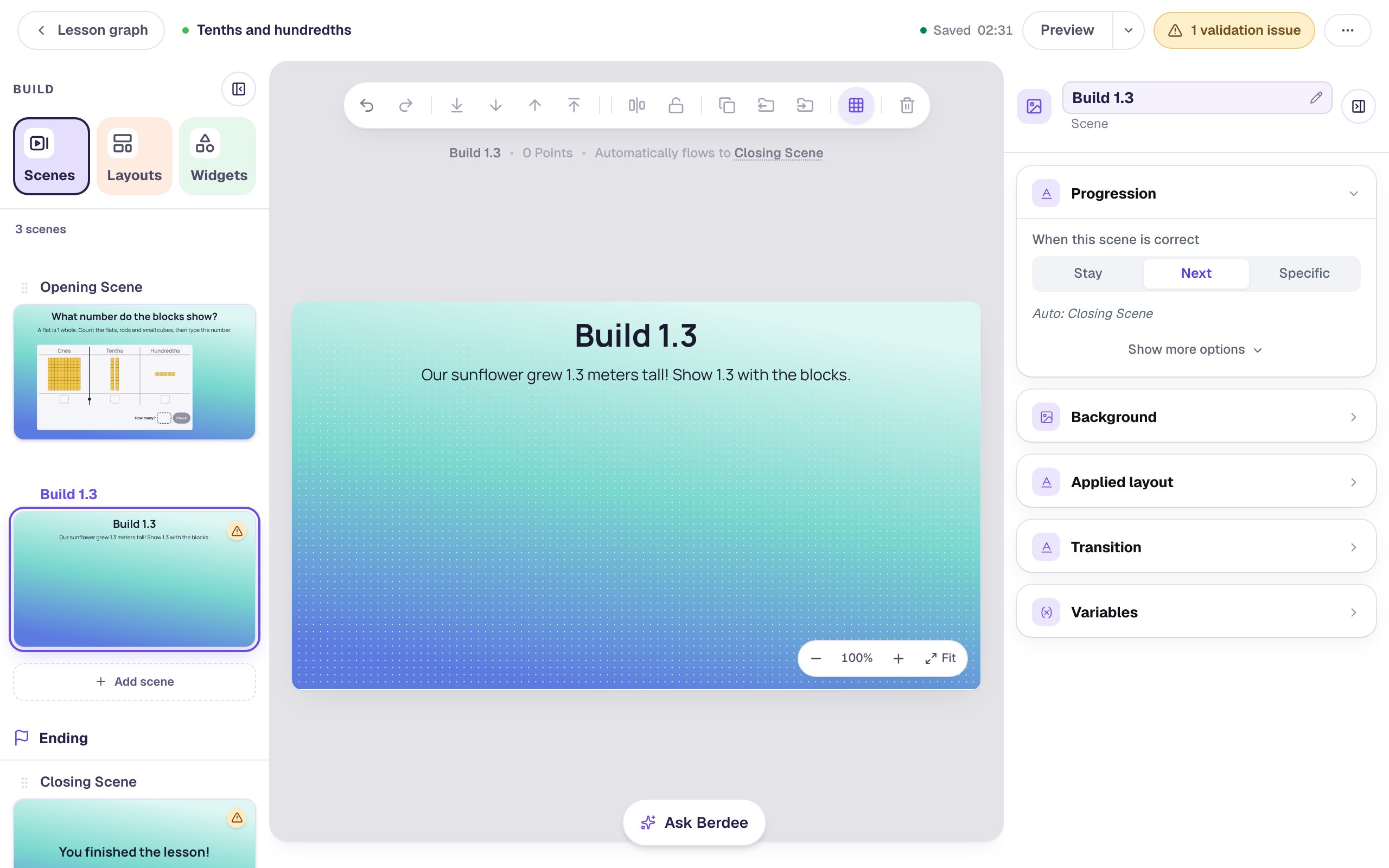
You can't duplicate the Opening Scene (the opening and ending scenes are fixed), so this scene starts empty.
Step 6: Set up the blocks to build
Add another Base-Ten Blocks widget, rename it Build the blocks, make it 680 wide and 390 tall, and drag it to the left under the sentence. In ⚙ Configure:
- Under What students do, choose Build.
- Under How the pieces look, set the same Blocks, Hundreds, Flat is 1 whole and Place-value chart.
- Under How it's checked, type
1.3in Target and set In this form to Standard. - Under What students build with, turn off Can break and make.
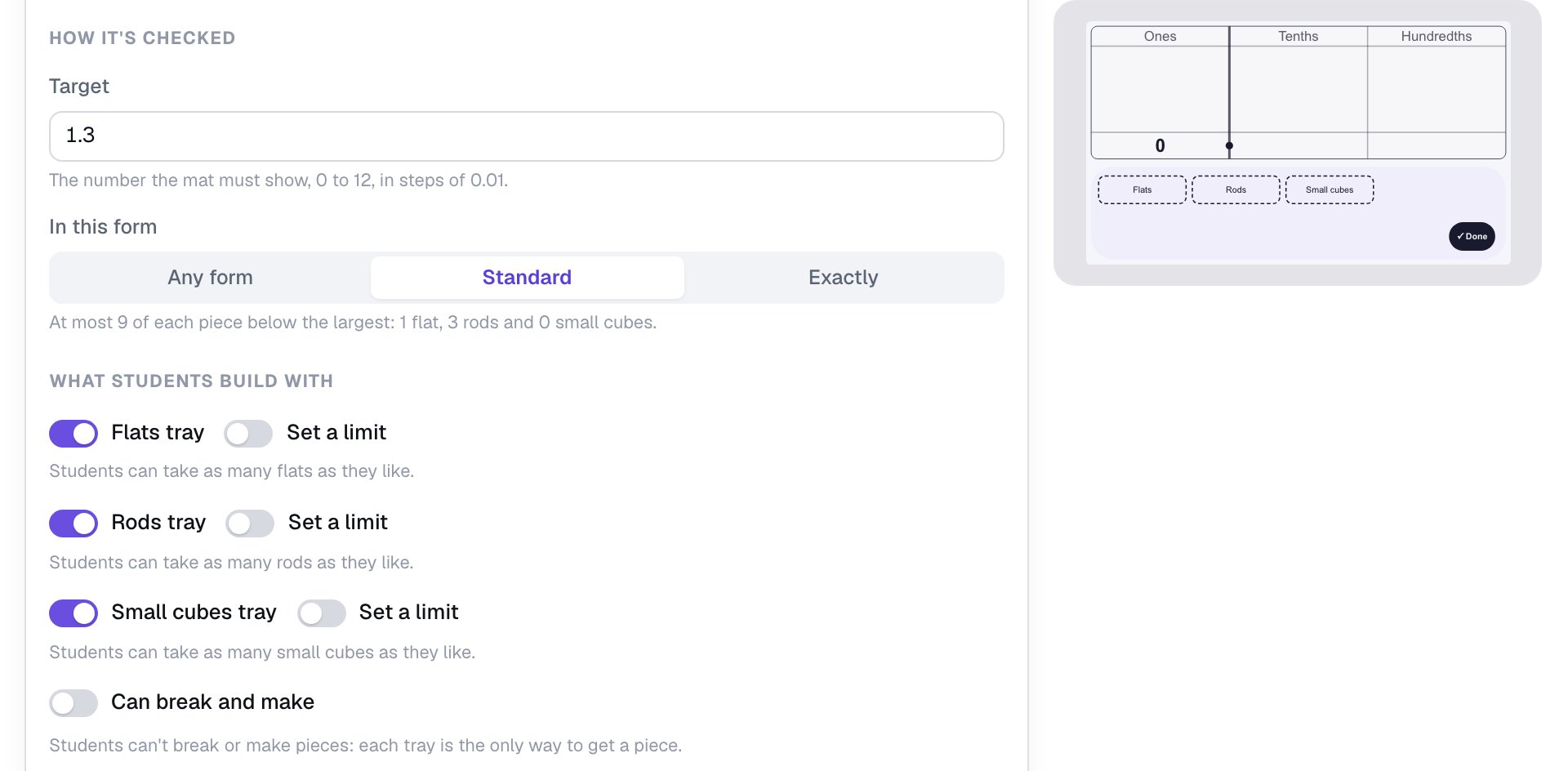
Standard accepts only the standard way to show 1.3: 1 flat and 3 rods. Thirteen rods are also worth 1.3, but they don't show what the digits mean. Turning off Can break and make keeps the lesson about place value: students can't trade a flat for 10 rods.
Then add an Image on the right, 200 wide and 260 tall. Click Choose image, search the stock photos for tall sunflower blue sky, and import a photo of a tall sunflower. Open its Accessibility section and type an Alt Text that says what's in the photo, for example A tall sunflower with a big yellow flower head against a blue sky.
Step 7: Show a hint for 1.03
The mistake to plan for is 1.03: 1 flat and 3 small cubes. A student who does that is treating the digit after the point as "some small cubes". Add a hint that sends them back to what each piece is worth.
- With Build the blocks selected, open Behaviors in the properties panel and click Add Behavior, then On Done.
- In the Display Message action, type
Not yet! A rod is one tenth and a small cube is one hundredth. How many tenths is 0.3?and set its style to Failure message. - Click Add Condition. Choose Base-Ten Blocks: Build the blocks, then Is incorrect.
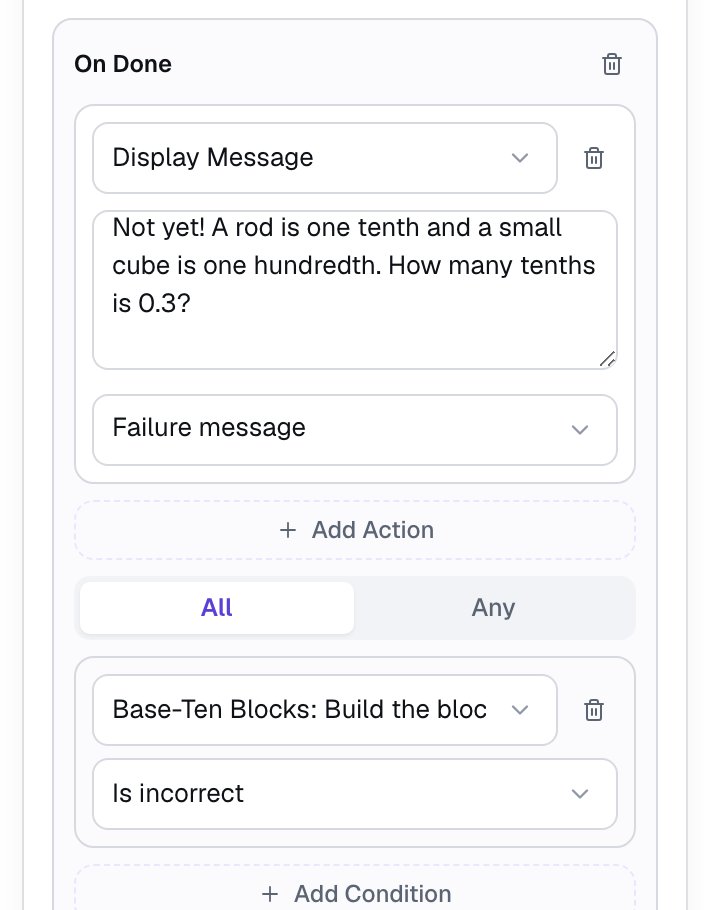
The hint ends with a question instead of the answer, so the student does the thinking: 0.3 is 3 tenths, so 3 rods.
Step 8: Give students a moment, and add "I'm done"
When the chart is right, the scene moves on by itself, which by default is too quick for a child to see the finished model. Click an empty spot on the scene, open Progression, click Show more options and set Advance delay to 3000 ms.
Then add the lesson's way out:
- Search the Widgets tab for
Submit Buttonand click it. - In Content, change Label to
I'm doneand set Submits to Lesson. - Set its Font Size to
18, give it a navy Background and white Text, and drag it under the photo.
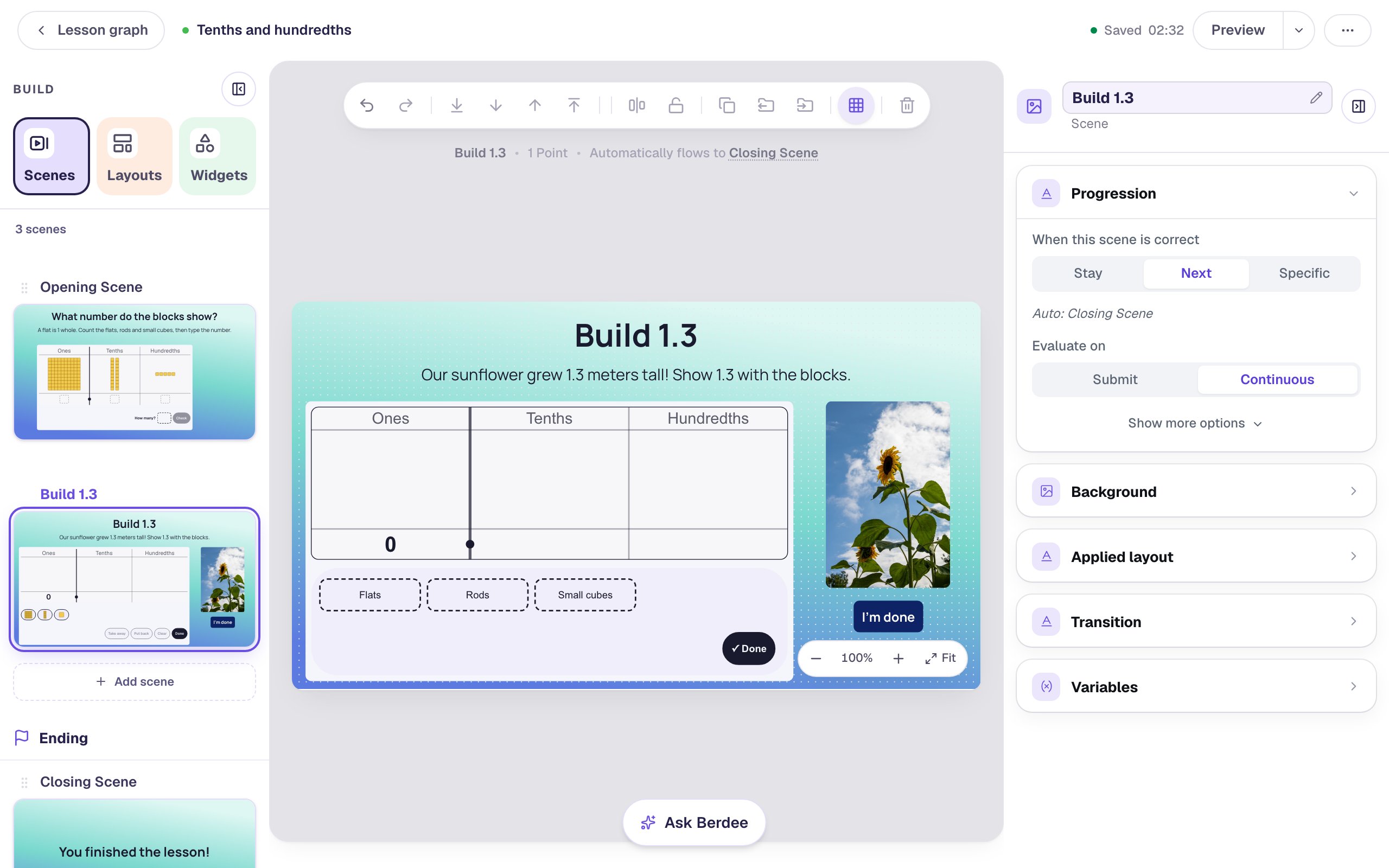
Keep I'm done away from the blocks' own Done button, so students don't tap the wrong one.
Step 9: Try it as a student
Click Preview. On the first scene, tap How many?, then type 1, ., 2 and 5 on the number pad.
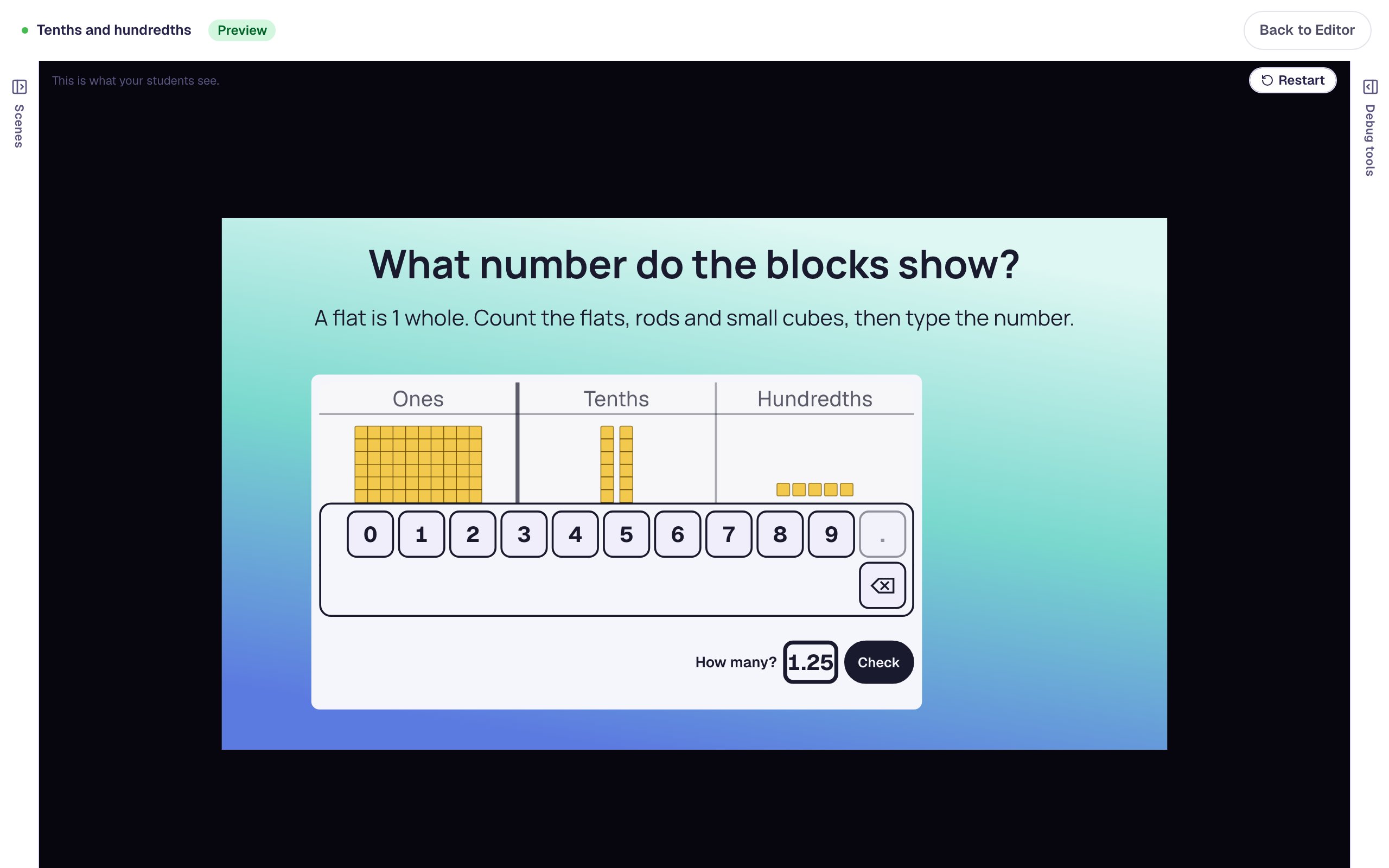
Tap Check, and the lesson moves on to Build 1.3. Make the mistake first: tap the flats tray once and the small cubes tray three times, then tap Done.
The chart shows 1.03, so the hint appears.
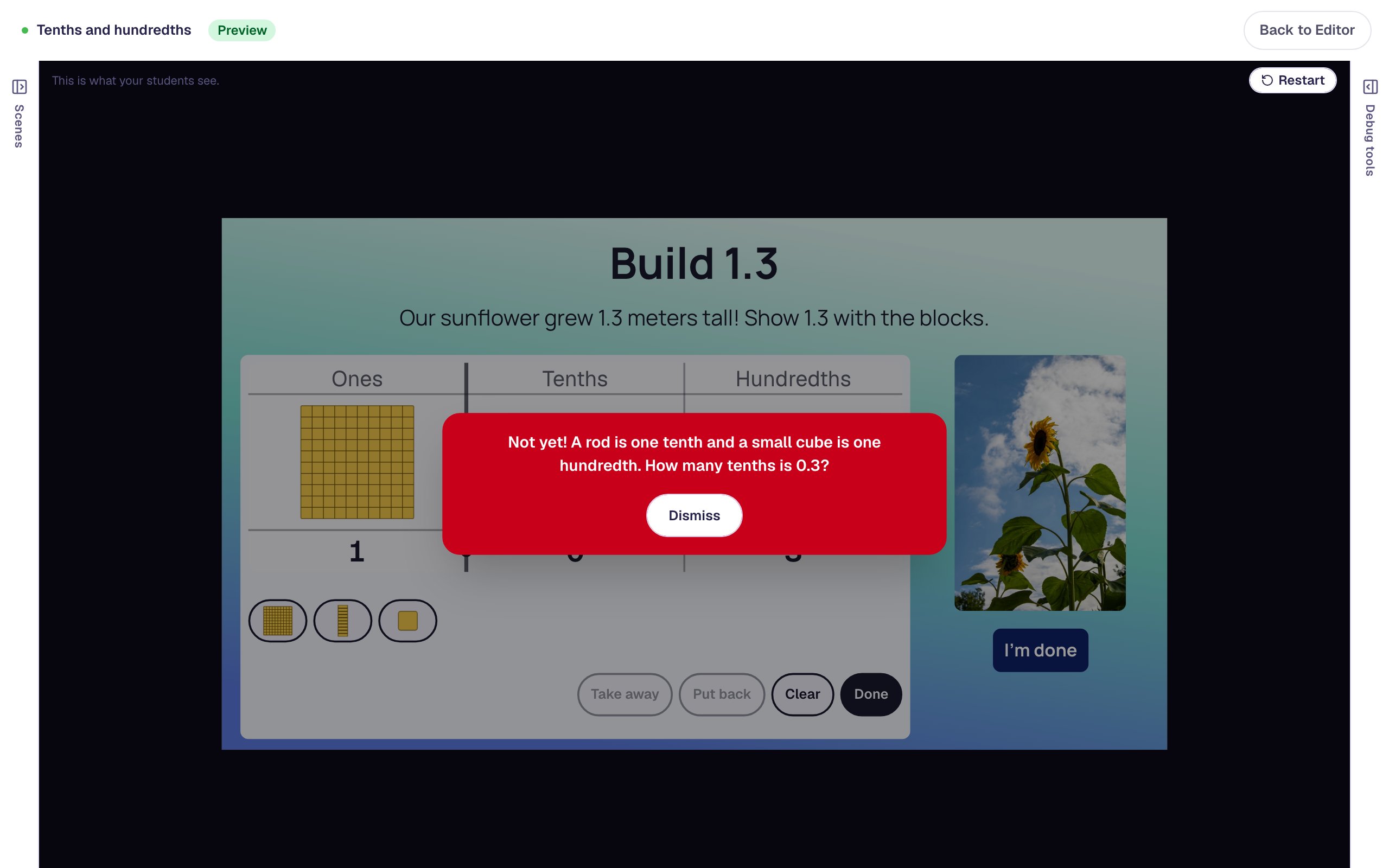
Now fix it: tap Dismiss, tap Clear, then tap the flats tray once and the rods tray three times, and tap Done.
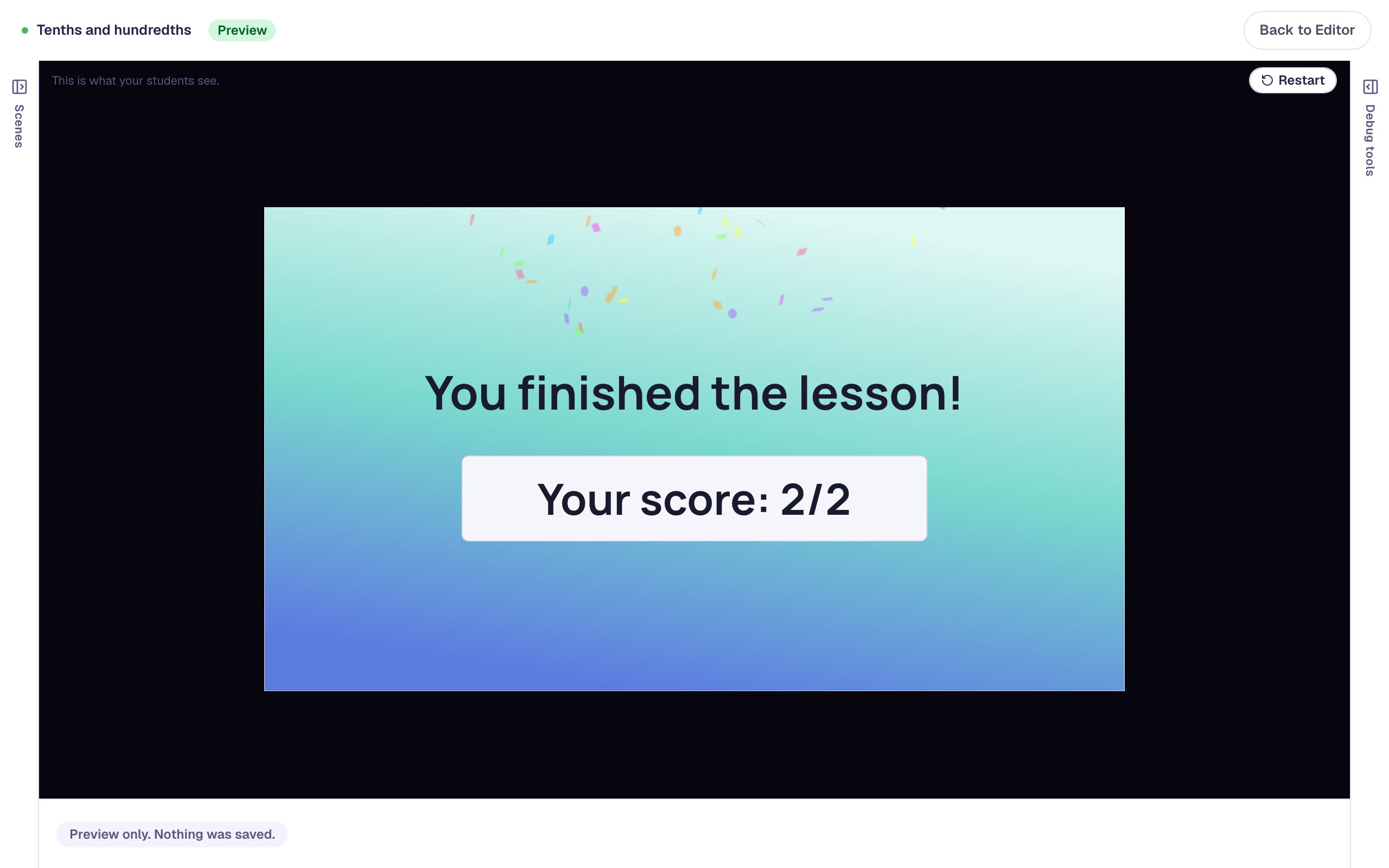
The score is 2 out of 2 even after the wrong try: a wrong Done is an attempt, not a lost point. On each student's attempt page you can see what they built, so you can find the students who wrote 1.03.
What you built
You built a two-scene decimals lesson with:
- Base-Ten Blocks in Show mode, with Unit set to Flat is 1 whole, so students read 1.25 from 1 flat, 2 rods and 5 small cubes,
- a second scene with Base-Ten Blocks in Build mode, asking for
1.3in Standard form on a Place-value chart, - an On Done hint for the 1.03 mix-up that shows only when the blocks are incorrect,
- a longer Advance delay, a photo with alt text, and an I'm done button.
To practice more, add more scenes with a different Target each: try 0.45 (no flat at all) and 2.07 (no rods), where the empty column is the hard part. For thousandths, set Largest piece to Thousands and Unit to Big cube is 1 whole: a flat becomes one tenth and a small cube one thousandth.
Make this lesson yours
Add the lesson you just watched being built to your account, then change it for your class: your questions, your pictures, your colors.
Free to sign up, and you'll come straight back here. I have an account